The Great Decoupling
Why the 3PL of 2026 is a Data Company That Owns Trucks
4/9/20264 min read
For decades, the backbone of the third-party logistics (3PL) industry was defined by physical assets: the square footage of a warehouse, the size of a tractor-trailer fleet, and the sheer number of manual laborers on a loading dock. But as we approach 2026, a silent transformation has reached its tipping point. The most successful logistics providers are no longer those with the most trucks, but those with the most fluid data.
This shift marks the end of an era dominated by "software erosion" and the beginning of the "API-first" logistics ecosystem. To understand where we are going, we must first look at the "digital prisons" that held the industry captive for forty years.
Software Erosion and the Green-Screen Digital Prison
In the software world, "Software Erosion" (also known as software rot or decay) does not refer to code physically vanishing. Instead, it describes the slow deterioration of a system’s performance and responsiveness as the environment around it evolves. A system built in 1995 might still "work," but if it cannot talk to a modern e-commerce platform or process a real-time tracking update, it has eroded into a liability.
For the logistics industry, the primary culprit of this erosion has been the IBM AS/400. Launched in 1988, these systems became the industry standard because of their legendary 99.9% uptime and security. However, their interface—the infamous "green screen"—became a digital prison.
These systems are "monoliths": massive, insular black boxes where the code for accounting, warehouse management, and shipping is all tangled together. In a green-screen environment, there are no buttons, no mouse interactions, and no intuitive workflows. Navigating these systems requires memorizing dozens of cryptic command codes and function keys—a process that can take a new warehouse employee 6 to 8 weeks to master.
In 2026, when e-commerce moves at the speed of a viral TikTok, a system that requires a 60-day learning curve isn't just old; it's an existential threat to the business.
The Transition: From the "Suite" to "Best-of-Breed"
For years, software vendors sold 3PLs on the "All-in-One Suite"—a single ERP (Enterprise Resource Planning) system that promised to do everything from inventory to payroll. The appeal was simple: one login, one database, one "neck to wring" when things went wrong.
However, these suites often suffered from the "jack of all trades, master of none" syndrome. The warehouse module was clunky, the transportation module lacked real-time GPS integration, and the accounting tool felt like a relic of the 90s. Worse, because the system was a monolith, you couldn't upgrade one part without risking the collapse of the entire structure.
The industry has now transitioned to a "Best-of-Breed" stack. Instead of one mediocre system, modern 3PLs use a decoupled architecture where they pick the absolute best tool for each specific job:
WMS (Warehouse Management): Focused on high-velocity picking and packing.
TMS (Transportation Management): Focused on load board integration and driver tracking.
Finance: Focused on automated billing and reconciliation.
By decoupling these functions, a 3PL gains "architectural agility." If a better WMS hits the market, they can swap it out without rebuilding their entire financial department.
Case Study: The Decoupled 3PL Transformation
Consider the transformation of a mid-sized 3PL that recently abandoned its legacy ERP in favor of a modern, decoupled stack.
Previously, this provider struggled with "manual chaos": spreadsheets were used to bridge gaps between their old WMS and their billing software, leading to constant errors and delayed shipments. By moving to a best-of-breed stack, they integrated three specialized powerhouses:
ShipHero (WMS): They implemented ShipHero to handle their e-commerce fulfillment. The intuitive interface reduced worker onboarding from weeks to less than 10 days.
Rose Rocket (TMS): For their trucking and freight operations, they used Rose Rocket, which provided real-time visibility for their shippers—a feature their legacy system physically could not support.
QuickBooks (Finance): Instead of using a proprietary accounting module, they synced their operational data directly into QuickBooks, ensuring that every "pick" in the warehouse was automatically turned into an "invoice" in the finance office.
The result was a doubling of output and a drastic reduction in customer service tickets, as clients no longer had to call to ask, "Where is my shipment?".
The API Advantage: The 10-Second Warehouse Trigger
The glue that holds this "Best-of-Breed" stack together is the API (Application Programming Interface). Specifically, the use of Webhooks has revolutionized the speed of logistics.
In the legacy era, systems used "polling": the warehouse computer would ask the sales server every hour, "Do you have any new orders?" This created massive delays. In contrast, a Webhook is a "push" notification. The moment an event happens in one system, it immediately tells the other system to take action.
Take TikTok Shop as an example. In 2026, social commerce is instantaneous. When a user buys a product on TikTok, the platform sends a Webhook—a tiny packet of JSON data—directly to the 3PL’s WMS.
0 Seconds: Customer clicks "Buy" on TikTok.
2 Seconds: TikTok’s Webhook hits the ShipHero API.
5 Seconds: The order is validated and assigned to a picking zone.
10 Seconds: A handheld device in the warehouse vibrates, alerting a picker to grab the item.
This happens without a single human in an office ever touching a keyboard. The data flows autonomously, turning a social media interaction into a physical shipment in under 10 seconds.
Conclusion: The 3PL as a Data Company
As we look toward the remainder of 2026, the definition of a logistics provider has fundamentally changed. Shippers no longer choose partners based on who has the newest trucks; they choose based on IT capabilities. In fact, 74% of shippers report they would switch 3PL providers based on their technology and AI capabilities.
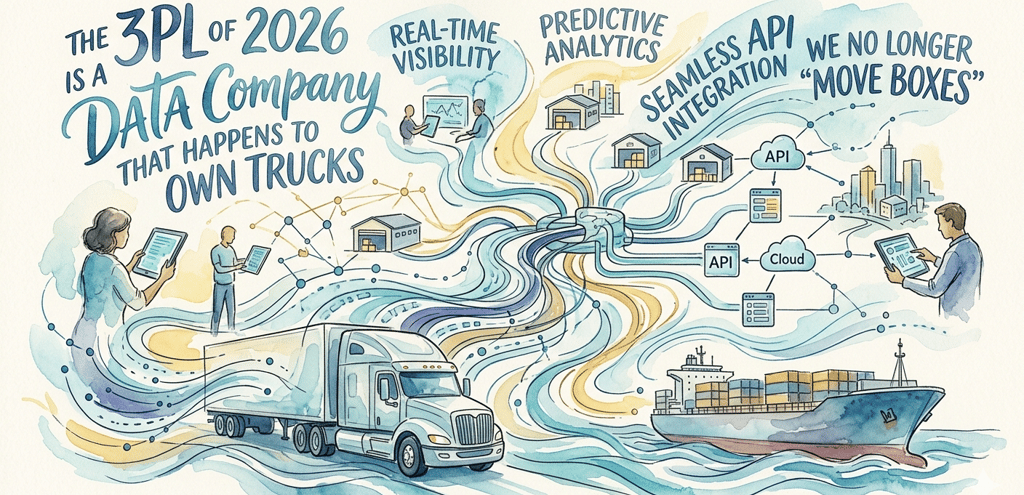
The 3PL of 2026 is a data company that happens to own trucks. Their value proposition is no longer "we move boxes"; it is "we provide real-time visibility, predictive analytics, and seamless API integration". By escaping the digital prison of legacy monoliths and embracing a decoupled, API-first architecture, these modern providers have turned logistics from a cost center into a competitive advantage. The era of the green screen is over; the era of the data-driven ecosystem has arrived.